Lifting nodules from the ocean floor, with air
A model, two prototypes and a series of tests.
Date: 2019–2020, completed in 2026
Metal-rich nodules lie 4,000 to 5,000 m down, and Ifremer studies a way to bring them up: air-lift pumping, where air blown into the bottom of a pipe makes the water rise with what it carries. With which settings is this pumping most efficient? That was our TIPE, the personal research project of the French preparatory classes, on the theme “Ocean”, led with Adrien Girardot at lycée Saint-Louis in 2019 and 2020: a model, two prototypes built, measurements on the first, and a report published because the 2020 oral exams were cancelled.
I always wanted to carry it on. In 2026 I took up the model, corrected the 2020 errors, which skewed its conclusions, and finished the report: 47 pages that say what dates from when, with no measurement added, and that give, for the trials never run, with beads, the model’s predictions and a protocol. To get back up to speed in physics and go further: a step towards science. The report can be read from this page.
The result
What was done
01
The model
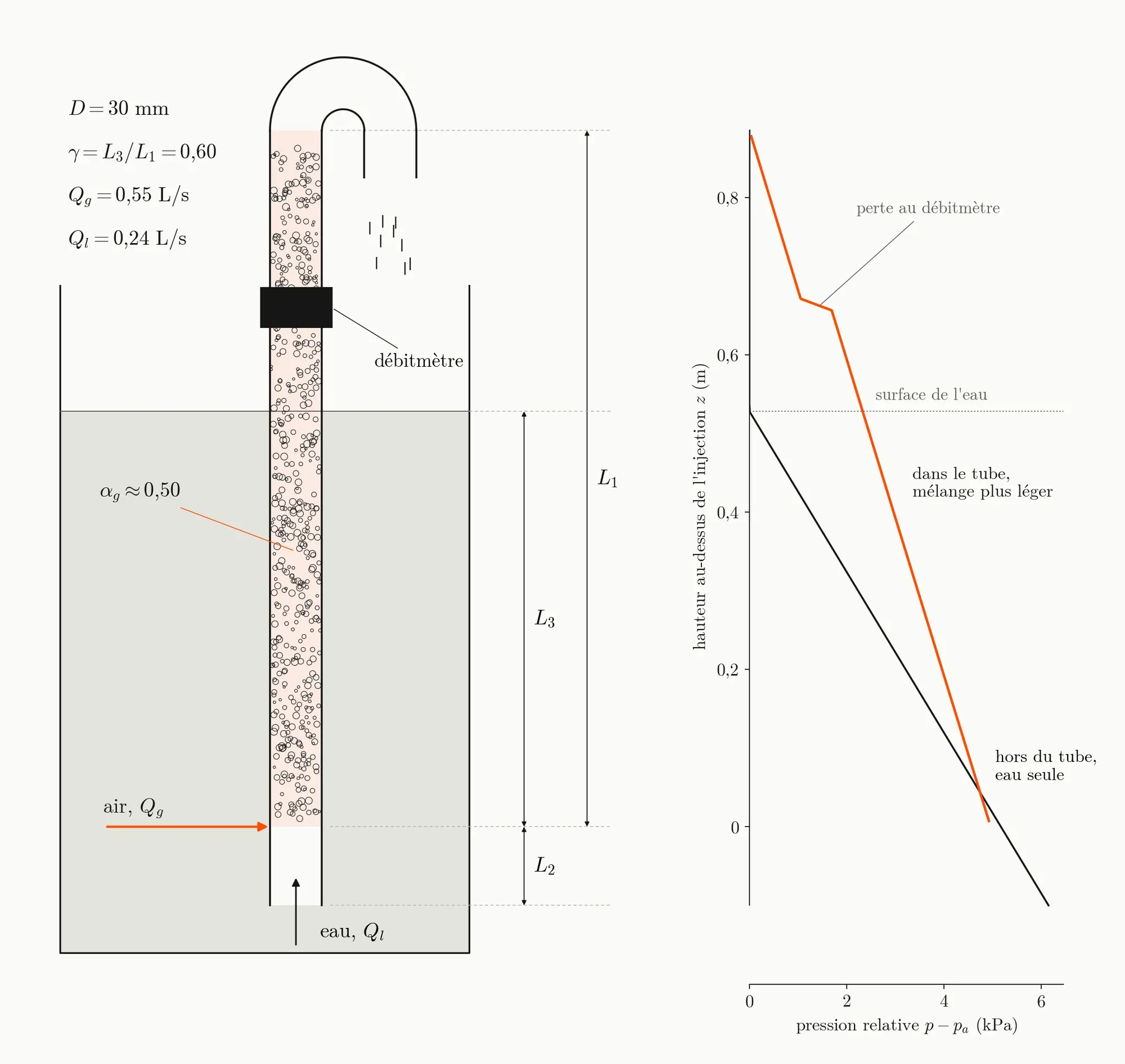
A balance of forces along the pipe, integrated step by step with the expanding air, the bubbles’ slip and friction, solved by bisection: for each setting, the water flow, the efficiency and the share of each loss.
Python · NumPy · SciPy
02
The two prototypes
The first, a 30 mm pipe in a tank, with a drilled injection chamber; the second, a loop with a 95 mm reservoir, a transparent pipe, the flowmeter below the injection and a mesh for the beads.
PVC · Plexiglas
03
The instrumentation
A Hall-effect flowmeter read by an Arduino and logged in Python, averaged over fifteen seconds; the air flow derived from the compressor’s pressure, calibrated with an anemometer; and, during the lockdown, a bicycle pump’s gauge read through a webcam.
Arduino Uno · Python · OpenCV
04
The trials
Two series on the first prototype: the water flow against the air flow, then against the immersion, compared with the model; the trials with beads, not run, replaced by a protocol.
05
The solids
The criterion for a particle to rise, the 5 mm beads, slurry against fragments, and a 4,500 m scenario in orders of magnitude.
Python
06
The report
Forty-seven pages, written in 2020 then completed in 2026, which say what dates from when and correct the 2020 errors; every figure and value regenerated by a program.
LaTeX · Matplotlib
How it works
Scroll: the drawing follows.
01 / 06
Bringing up nodules from 4,000 m down
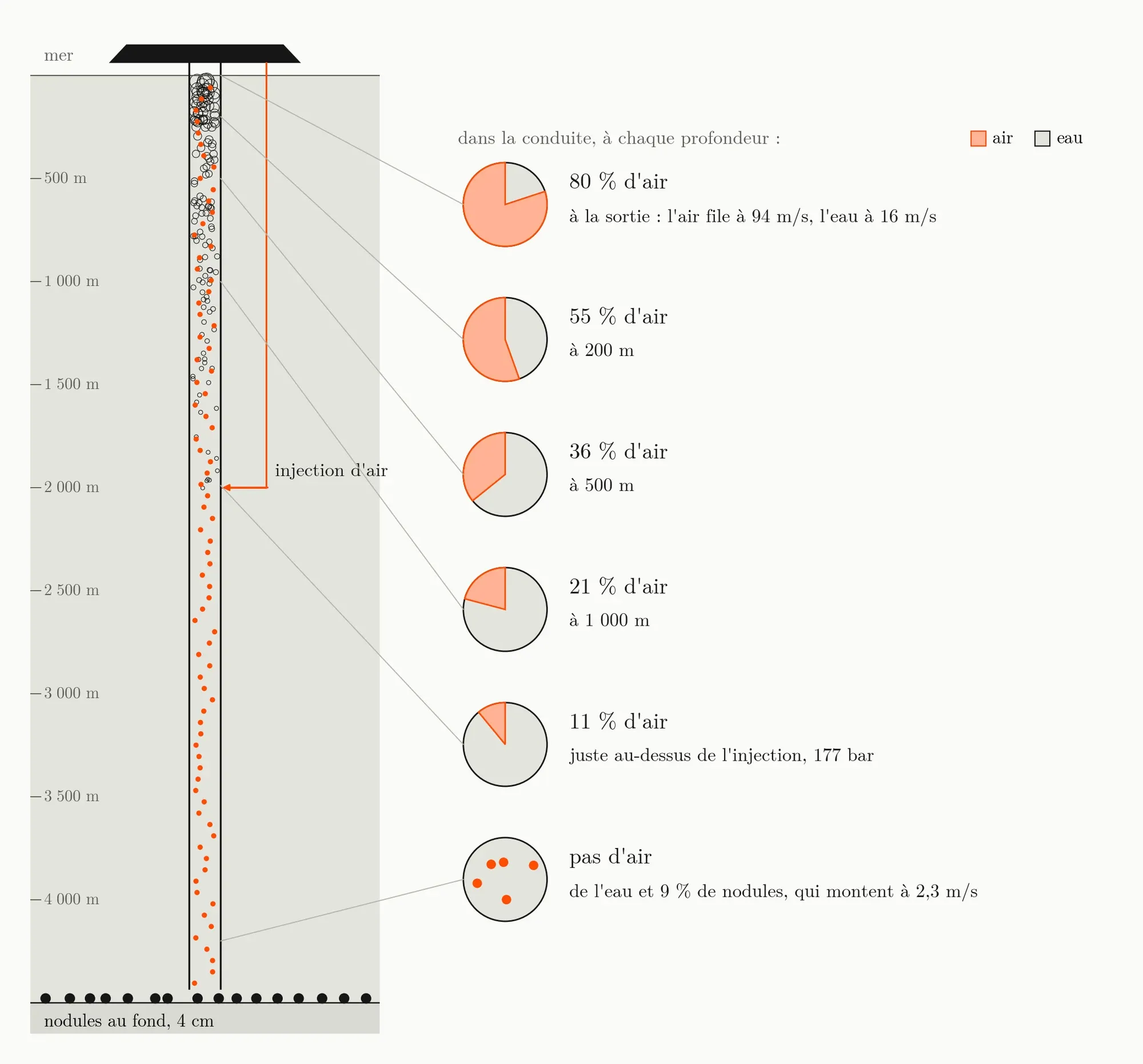
Metal-rich nodules lie 4,000 to 5,000 m down, and Ifremer studies a way to bring them up: air-lift pumping, tried at sea since the 1970s. With which settings is this pumping most efficient? The settings: the air flow, the only lever, the share of the pipe under water, the injection point, the size of the particles. The criterion: the useful power to raise the water, over the power it takes to compress the air.
02 / 06
Blow air into the bottom of a pipe
Air is injected as bubbles at the bottom of a pipe standing in water. The mix of water and bubbles, lighter than the water around it, is pushed upwards and carries what it holds: no moving part in the pipe, nothing to wear out. The method’s known flaw: its efficiency, rather low.
03 / 06
A model that predicts flow and efficiency
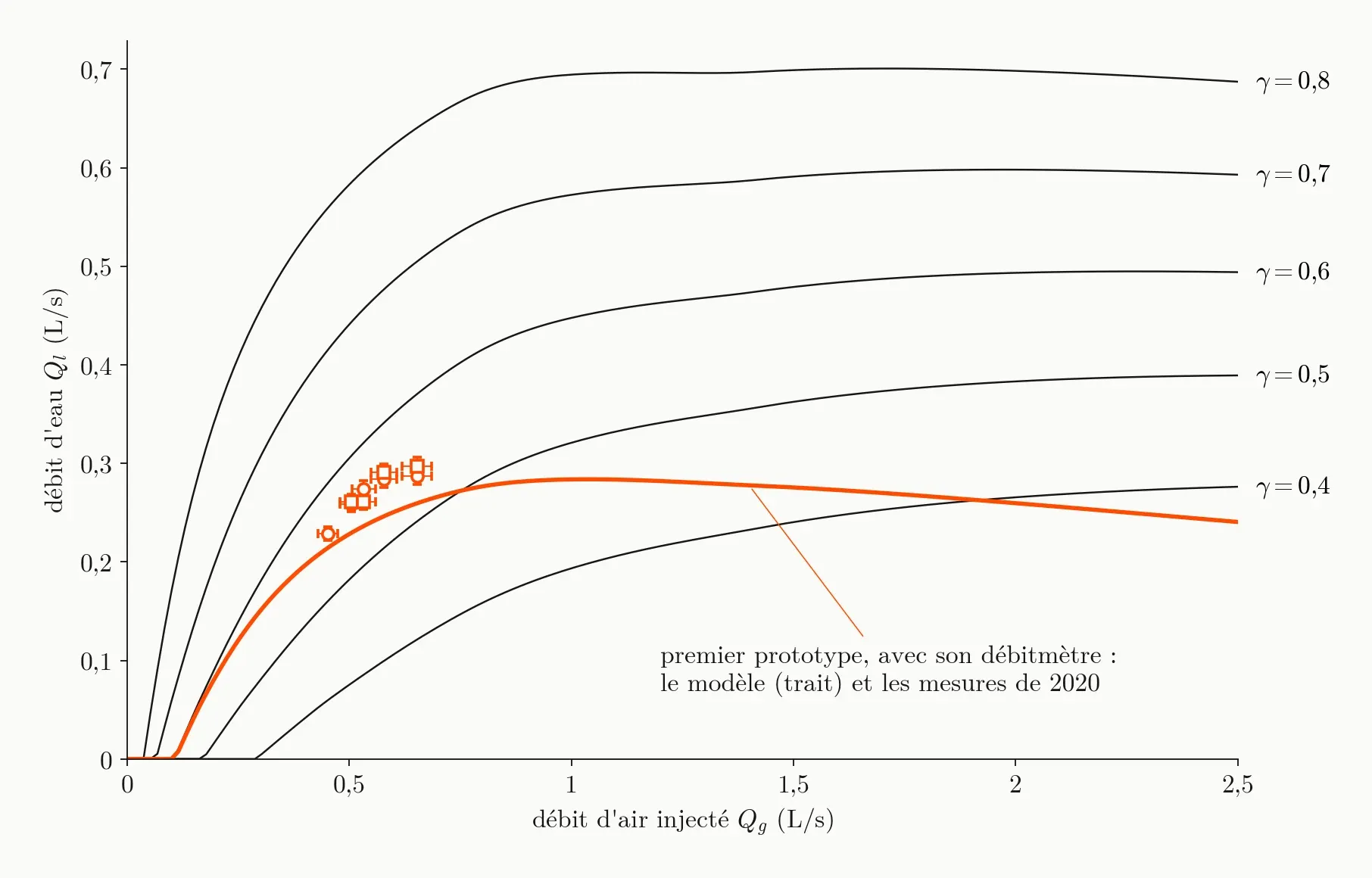
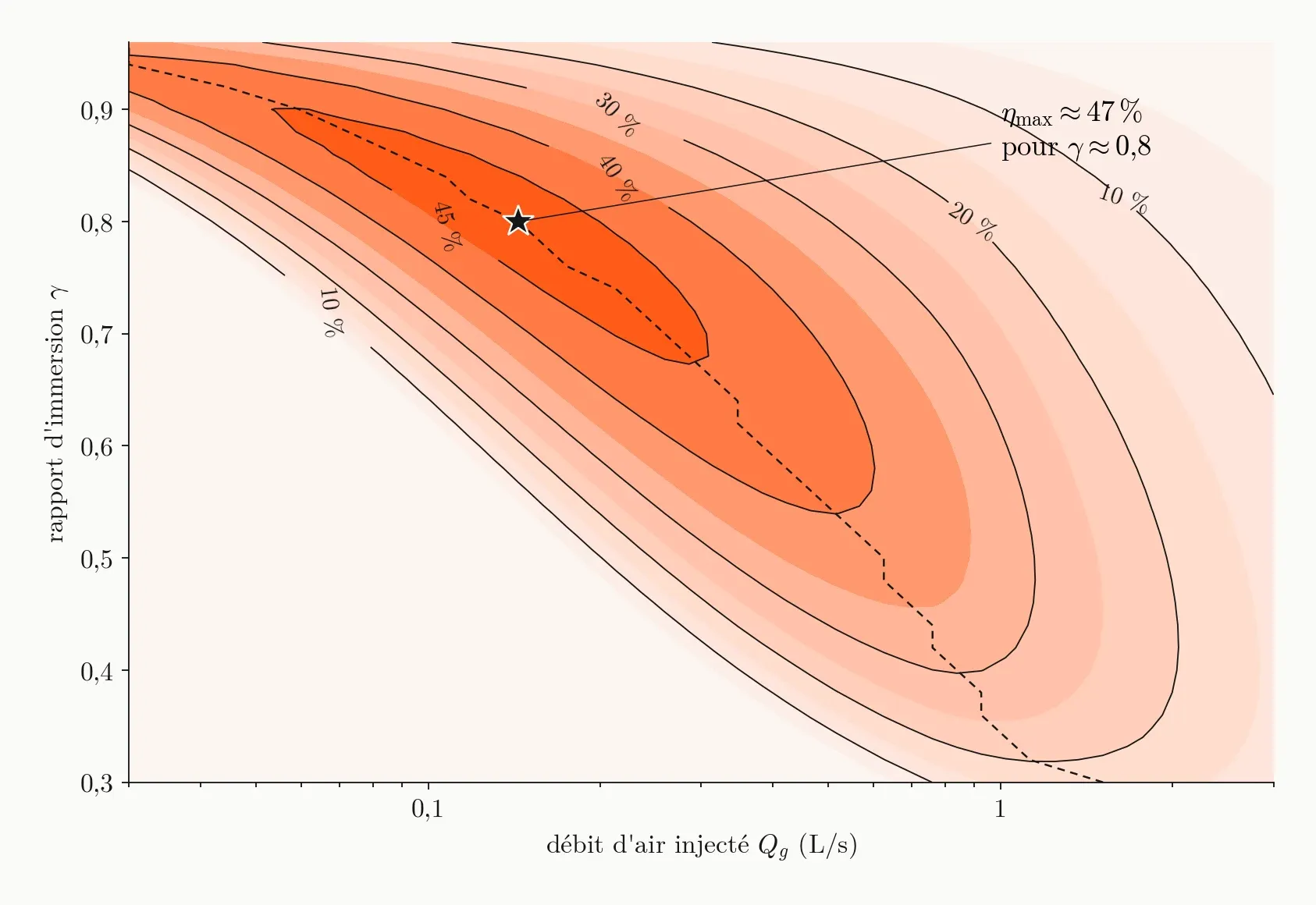
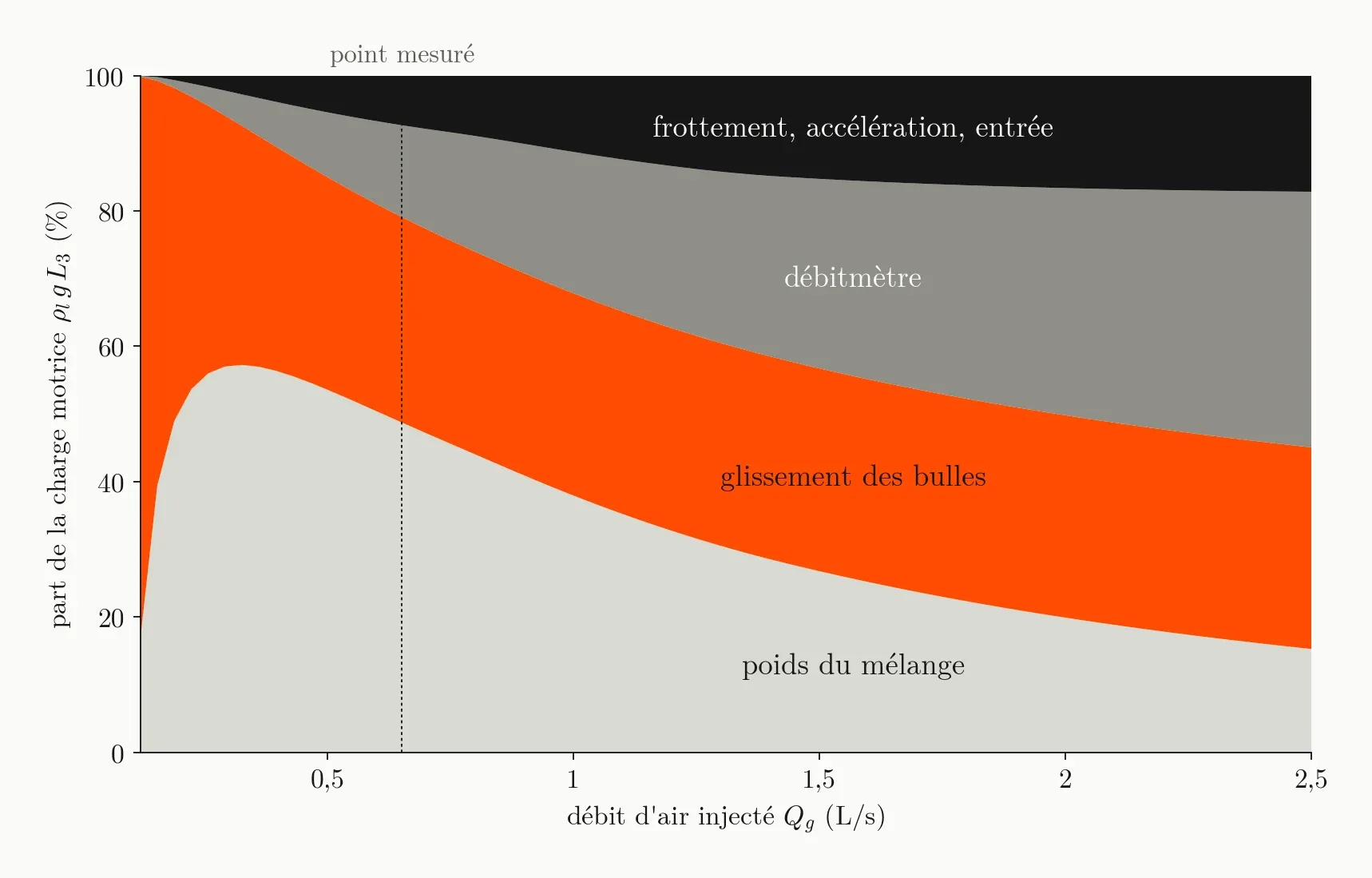
A balance of forces along the pipe, which accounts for the air expanding as it rises, the bubbles slipping through the water instead of carrying it, and friction, predicts the water flow and the efficiency for each setting. Below a minimum air flow, nothing rises. The bubbles’ slip is the first loss, about 30 % of the drive, friction under 3 %; the best efficiency, about 47 %, comes with four fifths of the pipe under water, and the largest flow is not the best efficiency.
04 / 06
Two prototypes on the bench
Two prototypes. The first, a 30 mm pipe in a tank, with a flowmeter read by an Arduino and its readings logged in Python; the air flow is derived from the compressor’s pressure, calibrated with an anemometer. The second, after a meeting with a professor at Arts et Métiers: a transparent pipe to film the flow, the flowmeter below the injection, in water alone, finer injection holes, and a mesh at the top to load the beads. During the lockdown, with no compressor, a program read the pressure off a bicycle pump’s gauge, through a webcam.
05 / 06
Measured flows, against the model
Two trials on the first prototype: the water flow against the air flow, then against the immersion. The measured flows have the predicted order of magnitude, a little above the model, but the flowmeter sat in the mix of water and bubbles and cannot validate it. The periodic spurts of slug flow were seen. The second prototype was not measured.
06 / 06
Lifting beads, and what comes next
A particle rises only if the water rises faster than it settles: 5 mm beads need, by the model, at least 0.23 L/s of air in the second prototype, and a slurry of fine grains lifts more easily than fragments. The trials with beads did not happen in 2020: the report, completed in 2026, gives their predictions, a protocol to run them, and a scenario at the scale of a 4,500 m pipe, in orders of magnitude.
Specifications
- Date
- 2019–2020, completed in 2026
- Context
- A personal scientific project, begun in preparatory classes at the Lycée Saint-Louis as a TIPE research project, that I wanted to carry on and finish.
- With
- Adrien Girardot
- Built with
- Python (NumPy, SciPy, Matplotlib, OpenCV) · Arduino Uno · FS300A flowmeter · LaTeX